
When growth starts to become disorganized
As companies grow, especially in digital environments, remote work stops being a simple advantage and begins to present real challenges. What initially worked in a flexible and natural way starts to become difficult to manage. Projects move forward, but not always with clarity. Teams work, but not always with the same efficiency.
The problem is usually not the people, but the lack of structure and visibility. Without the right tools, team leaders lose the ability to understand what is happening day to day, how time is being distributed, and where inefficiencies are being generated.
The real risk: working without real information
Many organizations operate for months, even years, without concrete data about their productivity. Decisions are made based on perceptions, feelings, or final results, but not on the process that leads to those results.
This creates a cumulative effect. Small inefficiencies that are not detected in time turn into delays, cost overruns, or even lost opportunities. Without visibility, optimization is impossible. And without optimization, growth becomes increasingly difficult to sustain.
The need for a solution designed for this context
In this scenario, generic tools or manual methods are not enough. Managing remote work requires solutions specifically designed to provide clarity without generating friction within the team.
This is where Hubstaff comes into play, a platform created to address this problem from the ground up. Its approach is not about control for the sake of control, but about providing accurate information to enable better decision-making.
From intuition to data-driven management
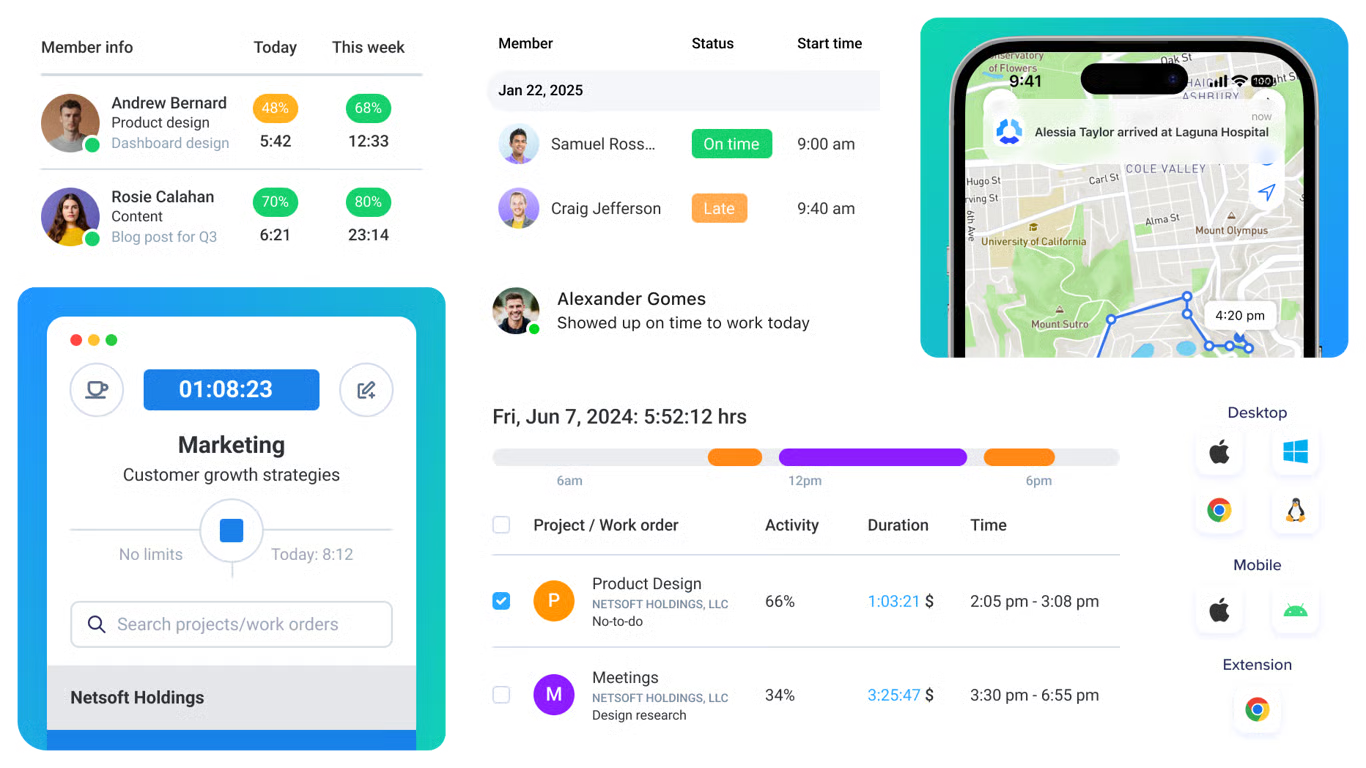
Implementing Hubstaff changes the way a company understands its operations. What used to be assumptions becomes concrete information. Time stops being an estimate and becomes a measurable, analyzable, and optimizable data point.
This visibility makes it possible to identify patterns, understand which tasks consume more resources than expected, and detect improvement points that would otherwise go unnoticed. The direct result is a more efficient operation, with clearer processes and better-aligned teams.
Productivity without losing flexibility
One of the biggest challenges of remote work is finding the balance between control and autonomy. Too much supervision can affect team culture, but lack of control creates disorder.
Tools like Hubstaff solve this balance by offering transparency without the need for micromanagement. Teams maintain their independence, but within a framework where performance is visible and measurable.
This change not only improves productivity, but also trust. Both the company and collaborators have clarity about goals, time, and results.
A strategic decision, not just operational
Adopting a solution like this is not simply about adding a new tool. It is about taking a step toward more mature management, where decisions are based on real data rather than intuition.
In increasingly competitive markets, this difference is key. Companies that manage to measure and optimize their operations have a clear advantage over those that continue working without visibility.
How to implement this solution in your company
At Aufiero Informática, we work with tools designed to solve real operational problems, and Hubstaff is one of them.
Our approach is not limited to offering the product, but to supporting its implementation so that it truly generates impact. Understanding how it fits into your workflow, how to integrate it with your current processes, and how to leverage its full potential is what makes the difference.
Conclusion
Remote work is not the problem.
The problem is managing it without visibility.
When a company adopts tools that allow it to understand and optimize its operations, growth stops being chaotic and becomes strategic. In that path, solutions like Hubstaff become a key ally to regain control and move forward with greater clarity.


