
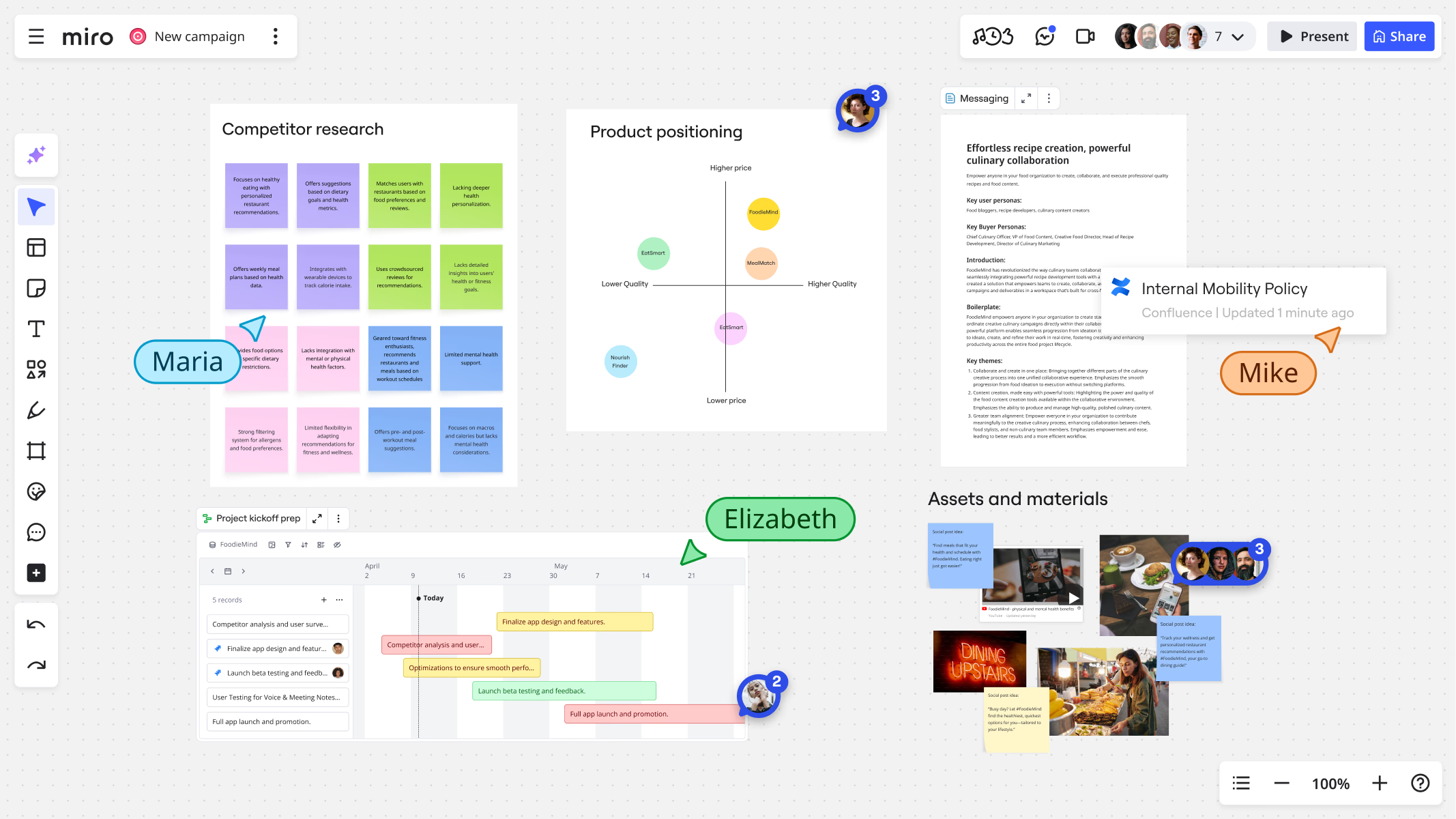
We live in the age of Artificial Intelligence, but there is a paradox that many leaders are starting to notice: while individual AI tools (like text or code generators) make people faster individually, teams seem to stall when trying to unify that work. That is the gap a shared visual workspace such as Miro is built to fill.
In fact, a recent study reveals an alarming statistic: 76% of leaders say most AI tools focus on the individual rather than the team. This creates what we call “silos of genius”: one person moves at full speed, but the project halts when it’s time to sync ideas, explain contexts, and translate documents.
If your team is using AI only to draft emails or summarize texts, they are missing out on the real revolution. Today, we want to educate you on the next evolutionary step: Miro’s AI Innovation Workspace, and why it is crucial for your company’s competitive survival.
The Problem of “Lost Context”
The biggest obstacle for traditional AIs is that they are “blind” to visual context. If you have a strategy drawn on a whiteboard, a complex flowchart, or a messy mind map, a normal chatbot cannot understand it.
This is where Miro changes the game with Visual Context Processing. Miro’s new technology doesn’t just “read” text; it “sees” your work. It can interpret the spatial clustering of sticky notes, understand the logic behind a process diagram, and even analyze the metadata of your wireframes.
• What does this mean for you? The canvas becomes the prompt. You no longer waste time writing long explanations to the AI; it already understands where you are and where you are going.
From Brainstorm to Deliverable in Seconds (Flows)
One of the biggest time sinks in companies is “work about work”: moving notes from a meeting to a document, then to a presentation, and finally to a management ticket.
Miro introduces Flows, a key educational feature for understanding modern automation. Imagine the following scenario:
1. Your team finishes a brainstorming session on the canvas.
2. Instead of manually transcribing, you run a Flow.
3. In seconds, the AI analyzes the board, extracts key themes, drafts a full Product Brief, and automatically generates tasks in your backlog.
The tangible result is a 50% reduction in planning processes and a 3.6x faster Time to Market.
Your New Hybrid Team: The “Sidekicks”
Miro has taken collaboration a step further with Sidekicks. These aren’t simple help bots; they are specialized AI agents that “live” on your board and act as team members.
You can summon different experts depending on the need of the moment:
• The Agile Coach: To facilitate retrospectives and ensure timing is met.
• The Product Strategist: To help you prioritize a backlog based on the company’s business goals.
• The Technical Architect: To turn diagrams and prototypes into production-ready code, thanks to integrations with tools like GitHub Copilot and Cursor.
Why is Aufiero Informática your best ally to implement Miro?
Understanding the tool is just the first step. Acquiring and implementing it correctly in a corporate environment in Latin America presents challenges that Aufiero Informática has been solving for over 20 years.
As leading software distributors and productivity specialists, we offer advantages that a direct credit card purchase cannot match:
1. Eliminate Payment Barriers: Forget about surprise international taxes or using personal credit cards. With Aufiero, you get local billing and can pay in your local currency, simplifying administrative management.
2. Real Adoption, Not Just Licenses: Buying software is easy; getting the team to use it is the hard part. We have a training program provided by our Sale Engineers, who teach your team how to use Flows and Sidekicks applied to their real projects.
3. Enterprise Security: As distributors of 100% original and authorized software, we guarantee your implementation meets security standards (such as Miro’s ISO 42001 certification) and provide technical support in your language.
4. Human Support: You are not just another ticket. Our team is available to resolve questions from installation to advanced user management.
Conclusion: Don’t Let Your Competition Innovate Faster
The difference between companies that lead and those that follow is no longer just talent, but the tools that allow that talent to collaborate without friction. Miro has ceased to be just a whiteboard to become the operating system of visual innovation.
Are you ready to equip your team with a “visual brain”? See licensing for Miro at Aufiero Informática, and full product details on the manufacturer’s official site at miro.com.
Why a chatbot cannot replace a shared workspace
A conversational assistant is excellent at producing an answer and poor at holding a shared understanding. Ask it the same question twice and you get two plausible answers with no record of why the team chose one. Miro works the other way round: the artefact persists, everyone sees the same version, and the reasoning stays attached to the diagram rather than living in somebody’s chat history.
The difference matters most for problems that are spatial rather than linear. A customer journey, a system architecture, a dependency map or a quarter of planning are all easier to reason about when they are laid out in two dimensions. Text flattens those relationships; a board in Miro keeps them visible, which is why teams reach a decision faster even when the underlying analysis is identical.
Participation is the other half. In a document, one person writes and the rest comment. On a shared canvas, ten people contribute at once and the quiet ones contribute as much as the loud ones, because adding a note costs nothing socially. That shift in who speaks is often the largest practical gain, and it is invisible in any feature comparison.
Making Miro stick beyond the first workshop
The common failure is treating the board as a workshop artefact that dies when the session ends. Boards that survive are the ones wired into an ongoing process — a live roadmap, a retrospective series, an architecture that gets updated as it changes. If nobody has a reason to reopen the board on a Tuesday, the tool becomes a nice memory of an offsite.
Structure helps more than most teams expect. An unmanaged Miro account accumulates hundreds of untitled boards within a year, and finding last quarter’s decision becomes archaeology. Agreeing on naming, ownership and a small set of templates early costs an afternoon and saves the tool from quietly becoming unusable.
Finally, connect it to where work actually happens. A board that links to the tickets, documents and repositories it describes stays current because updating it is part of the work. One that lives in isolation goes stale, and a stale board is worse than none, because people trust it briefly before discovering it is wrong.
Frequently asked questions about visual collaboration
What does a “visual brain” mean for a team?
A single space where the team’s thinking stays visible: ideas, connections, decisions and open items on the same board, instead of scattered across documents, messages and the memory of whoever attended the meeting.
Why does a chatbot not replace that?
Because it answers questions but does not hold collective reasoning. Innovation depends on seeing how ideas relate and on several people building on the same material — that calls for a shared space, not a conversation.
What is “lost context” and how is it avoided?
It is information that was decided but never recorded anywhere retrievable. It is avoided when the discussion and its outcome live in the same place, with history, rather than in scattered notes.
Where does AI fit into a collaboration platform?
In the tasks that consume a team’s time: clustering hundreds of notes by theme, summarising a long session, turning discussion into an action plan, and drafting a first version from what is already on the board.
How do you make the tool survive the initial enthusiasm?
By tying the board to a ritual that already exists — planning, retrospective, kickoff — instead of asking the team to add one more tool to their routine.
How can Miro be contracted in Latin America?
Aufiero Informática distributes Miro across Latin America, with local support and regional commercial terms, and can advise on plans according to team size and administration needs.


